There is something almost embarrassing about being frightened by a ghost story.
No blood.
No violence.
No visible threat.
And yet — the fear lingers longer than anything else.
Because ghost stories do not attack the body.
They dismantle certainty.
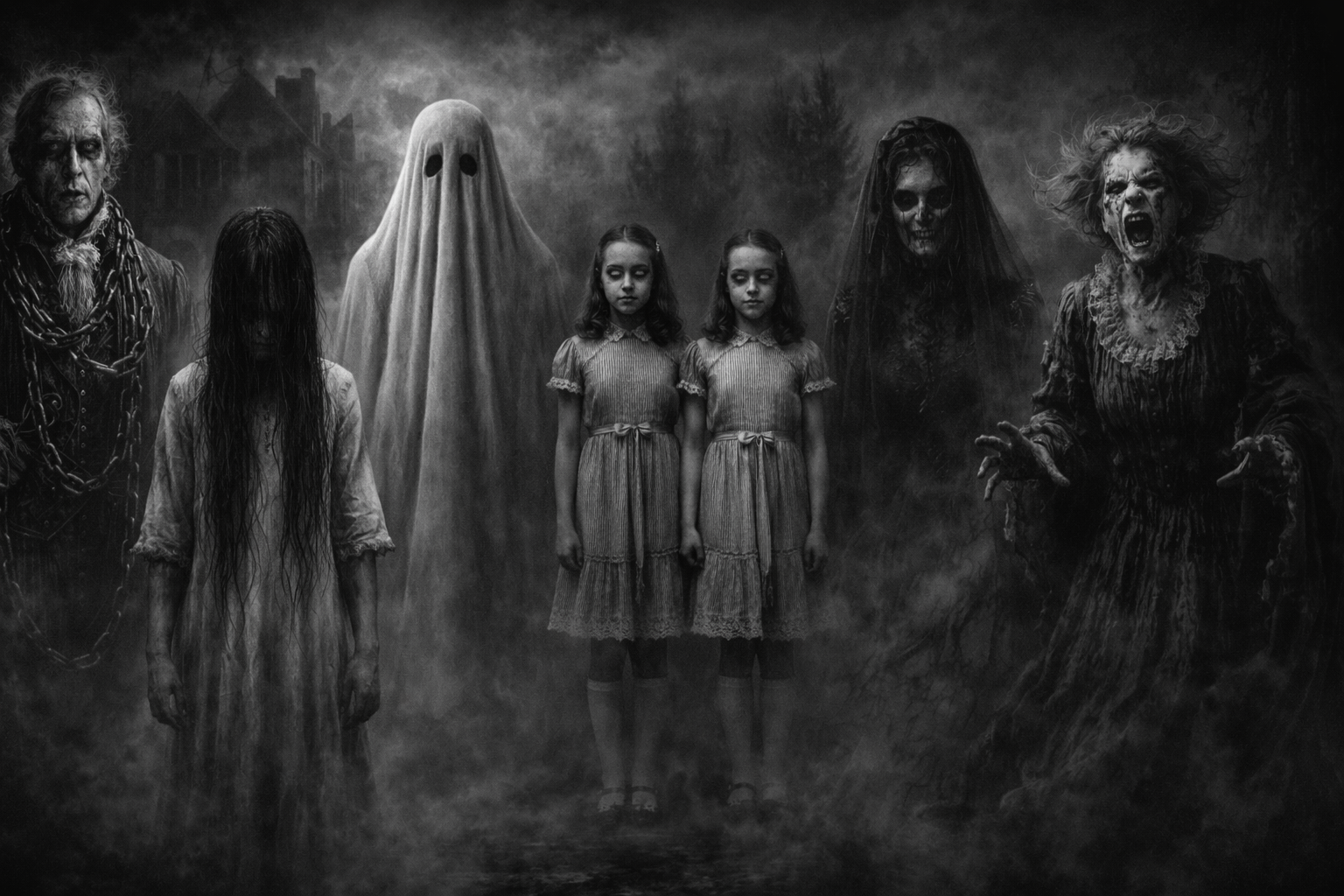
Gothic Gathering of Iconic Ghosts
The Oldest Fear Isn't Death — It's Presence
Strip horror back to its most basic components and you are left with a simple, enduring question:
What if you are not alone?
Not in the obvious sense.
Not in the way of footsteps behind you on a dark street.
Something quieter.
Something already there.
Ghost stories exploit a deeply embedded psychological reflex — the sense of unseen presence. Evolution taught us to detect patterns, to anticipate movement, to assume that the rustle in the dark might be something watching us.
A ghost story doesn't need to show the threat.
It only needs to suggest that the threat has been there all along.
The Architecture of the Unseen
Unlike modern horror, which often relies on escalation — louder, faster, more explicit — ghost stories operate through subtraction.
They remove information.
A closed door becomes significant.
A quiet room becomes unstable.
A familiar space becomes unknowable.
This is why the haunted house remains the most powerful setting in horror.
Not because it is dangerous.
But because it is familiar.
A house is where we understand the rules:
- Doors lead somewhere
- Floors hold weight
- Rooms remain as we left them
A ghost story rewrites those rules without announcing the change.
And once that happens, the reader is no longer safe — because the world itself can no longer be trusted.
This is the principle at the heart of my novel, THE HOUSE — where structure itself becomes the threat, and certainty erodes one room at a time.
Why Absence Is More Powerful Than Violence
Graphic horror shows you the threat.
Ghost stories withhold it.
And in that gap, the mind does something remarkable:
It completes the horror on its own.
This is not a weakness in the form.
It is its greatest strength.
Because what the reader imagines will always be more personal — and therefore more terrifying — than anything described on the page.
A shadow at the end of a hallway is frightening.
But the idea that the shadow wasn't there a moment ago is far worse.
The Persistence of the Past
At their core, ghost stories are not about monsters.
They are about memory.
Something unresolved.
Something unfinished.
Something that refuses to stay buried.
This is why they endure.
Every culture tells them.
Every generation reshapes them.
Because they speak to a universal discomfort:
The idea that the past is not past at all.
That places remember.
That actions echo.
That something — somewhere — is still waiting to be acknowledged.
A More Intelligent Fear
Modern audiences are often described as desensitised.
Harder to scare.
More demanding.
More aware of genre conventions.
And yet, ghost stories continue to work.
Not because they have evolved into something louder —
but because they have remained precise.
They respect the audience.
They don't overwhelm.
They invite.
They allow the reader to participate in their own fear — to lean forward, to question, to doubt what they are seeing.
And once that participation begins, the story no longer needs to push.
The reader does the rest.
Why They Still Work — And Always Will
Ghost stories endure because they target something fundamental:
- The fear of being watched
- The fear of losing control of your environment
- The fear that reality is not fixed
But more than that, they exploit a quieter, more unsettling idea:
That the world is not as empty as it appears.
And that if you stay still long enough…
you might notice.
Closing
Some stories scream.
Ghost stories don't.
They wait.
This article is part of the Origins of Horror series exploring why certain stories continue to terrify us.
If you enjoy exploring the psychology behind horror storytelling, you might also like:
Week 1: The Origins of Horror — Where Gothic Fear Began
How the earliest gothic writers created the foundations of modern horror fiction.
Read Week 1 →Week 2: The Origins of Horror — Why Haunted Houses Terrify Us
Read Week 2 →Coming Next:
The Psychology of Fear